
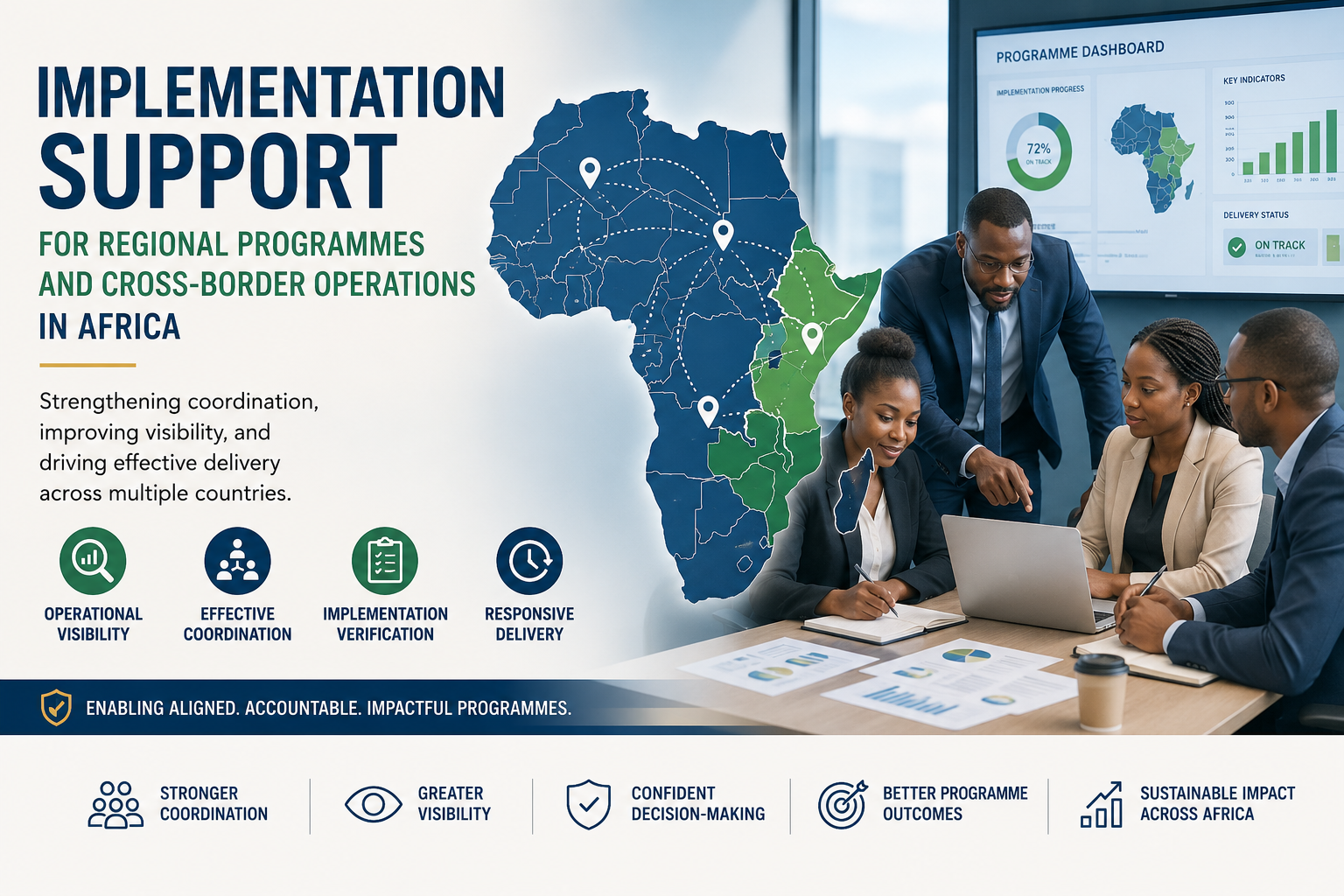
Implementation support is becoming increasingly important as regional programmes expand across multiple countries, stakeholders, implementing partners, and operating environments. While growth creates new opportunities, it also introduces operational complexity that can quietly weaken programme delivery if organisations lack the systems to maintain visibility, coordination, and alignment.
In our previous articles, we explored how operational drift develops and why effective regional programme management depends on strong operational visibility. The next question is both practical and strategic:
How can organisations prevent operational drift before it affects programme outcomes?
The answer is not simply more reporting or additional meetings. In our experience, successful organisations strengthen the operational disciplines that keep leadership connected to implementation. They invest in implementation support that improves programme coordination, verifies progress, strengthens stakeholder engagement, and enables informed decision-making across multiple countries.
This article explores how implementation support helps governments, donor agencies, NGOs, development partners, and international organisations deliver regional programmes more effectively across Africa, while maintaining confidence that implementation remains aligned with strategic objectives.
Table of Contents
- Why Regional Programmes Become More Complex
- Why Implementation Support Matters
- High-Performing Programmes Stay Close to Delivery
- The Four Pillars of Effective Implementation Support
- Common Signs Your Programme Needs Additional Support
- How EP Martins Advisory Supports Regional Programmes
- Frequently Asked Questions
- Key Takeaways
Why Regional Programmes Become More Complex
Every regional programme begins with a clear strategy.
Objectives are agreed.
Governance structures are established.
Implementation plans are approved.
Budgets are allocated.
Roles and responsibilities are defined.
Yet as implementation progresses, programmes begin encountering realities that cannot always be predicted during planning.
Each participating country introduces unique political, institutional, operational, and stakeholder dynamics.
Government priorities evolve.
Regulatory environments change.
Funding conditions shift.
Implementing partners interpret guidance differently.
Stakeholder expectations continue to develop throughout programme delivery.
None of these changes necessarily indicate programme failure.
They simply reflect the realities of implementing programmes across multiple operating environments.
The challenge is that complexity grows gradually.
Leadership often remains confident that implementation is progressing according to plan because reporting continues to indicate positive progress.
Meanwhile, country teams are making operational decisions every day to adapt to local realities.
These decisions are often appropriate.
However, without structured coordination, they can gradually reduce consistency across the programme.
This is why successful regional programme management depends on more than planning.
It depends on maintaining operational alignment throughout implementation.
Implementation support provides the structures that help organisations maintain that alignment as programmes become increasingly complex.
Why Implementation Support Matters
Implementation support is often misunderstood.
Some organisations associate it with administrative assistance or additional project resources.
Others view it as temporary operational capacity during periods of increased workload.
While implementation support may include these activities, its true purpose is much broader.
Implementation support strengthens the operational disciplines that enable successful programme execution.
Rather than replacing programme management, it complements it.
Programme management focuses on strategic oversight, governance, budgeting, contracts, performance management, and decision-making.
Implementation support focuses on ensuring those decisions translate into consistent implementation across multiple countries.
This includes improving communication between regional leadership and country teams.
Supporting programme coordination.
Verifying implementation activities.
Monitoring operational risks.
Facilitating stakeholder engagement.
Providing independent operational insight.
Strengthening regional reporting.
Supporting delivery assurance.
The objective remains remarkably consistent across every programme.
Help leadership understand what is changing while there is still sufficient time to respond.
Strong implementation support enables organisations to move beyond simply tracking activities.
It helps them understand whether implementation remains aligned with programme objectives.
As regional programmes continue expanding across Africa, this operational visibility becomes increasingly valuable.
High-Performing Programmes Stay Close to Delivery
One observation consistently emerges across successful regional programmes.
The strongest organisations do not necessarily exercise more control.
Instead, they maintain a closer connection to implementation.
Leadership does not wait for monthly reports to discover operational challenges.
Country teams feel comfortable escalating emerging issues before they become delivery risks.
Implementing partners communicate openly about implementation realities.
Stakeholder feedback is captured continuously rather than retrospectively.
Operational information moves quickly between countries, allowing lessons learned in one location to strengthen implementation elsewhere.
This approach creates something far more valuable than increased oversight.
It creates confidence.
Leadership understands not only what has been completed but also what is changing.
Emerging challenges become visible earlier.
Country teams receive support sooner.
Programme adjustments are made before implementation begins drifting away from strategic objectives.
Ultimately, successful regional programmes are not defined by the absence of problems.
They are defined by the speed with which organisations identify, understand, and respond to those problems.
That capability is one of the defining characteristics of effective implementation support.
The Four Pillars of Effective Implementation Support
Strong implementation support does not eliminate complexity.
Regional programmes will always involve multiple stakeholders, changing operating environments, evolving priorities, and country-specific implementation realities.
The objective is not to remove complexity.
It is to ensure that complexity remains visible, coordinated, and manageable throughout programme delivery.
From our experience supporting regional programmes across Africa, effective implementation support consistently strengthens four operational disciplines.
Together, these disciplines help organisations maintain alignment, improve decision-making, and reduce the likelihood of operational drift.
1. Operational Visibility
Visibility is the foundation of effective implementation.
Without it, leadership cannot make informed decisions, allocate resources effectively, or identify emerging delivery risks.
Unfortunately, visibility is often confused with reporting.
Receiving monthly reports from every country does not necessarily provide an accurate picture of programme implementation.
Reports frequently answer one question:
What has happened?
Leadership also needs to understand:
- Why has implementation changed?
- What challenges are emerging?
- Which countries require additional support?
- What risks are developing beneath the reported indicators?
- Where are implementation approaches beginning to diverge?
Effective implementation support improves operational visibility by ensuring leadership receives timely, relevant, and actionable information—not simply more information.
It connects strategic oversight with operational realities.
Rather than reacting to implementation challenges after they affect delivery, leadership gains the confidence to respond while there is still time to influence outcomes.
2. Programme Coordination
Regional programmes depend on multiple organisations working towards common objectives.
Government institutions.
Development partners.
Implementing agencies.
Consultants.
Community organisations.
Private sector partners.
Each contributes to programme delivery.
Each also introduces different priorities, reporting requirements, organisational cultures, and decision-making processes.
Without deliberate coordination, these differences gradually weaken programme alignment.
One country may prioritise implementation speed.
Another may focus primarily on compliance.
A third may respond to changing stakeholder expectations.
Each decision appears reasonable when viewed individually.
Collectively, however, they begin to reshape programme implementation.
Effective implementation support strengthens coordination by ensuring that regional leadership, country teams, and implementing partners remain aligned around shared programme objectives.
It creates structured communication channels.
Clarifies responsibilities.
Supports timely decision-making.
Encourages collaboration across countries.
Most importantly, it ensures that local adaptations continue supporting regional priorities rather than unintentionally moving programmes in different directions.
Strong coordination reduces duplication, improves efficiency, and enables organisations to deliver more consistent outcomes across multiple operating environments.
3. Implementation Verification
One of the most overlooked aspects of regional programme delivery is implementation verification.
Many organisations assume that reported progress accurately reflects implementation on the ground.
In many cases, it does.
However, regional programmes operate across diverse environments where operational realities can change quickly.
Implementation verification provides independent confirmation that activities are being delivered as intended.
It helps answer critical operational questions.
- Are planned activities actually taking place?
- Are stakeholders receiving the intended support?
- Are implementation partners following agreed approaches?
- Are programme outputs translating into meaningful progress?
- Are reported achievements consistent with field realities?
Verification is not about creating additional oversight.
Nor is it about questioning the work of implementing teams.
Instead, it provides leadership with greater confidence that programme information reflects operational reality.
When organisations verify implementation regularly, they identify issues earlier, improve accountability, strengthen donor confidence, and reduce implementation risks before they become significant delivery challenges.
Implementation support plays a central role in making this verification practical, consistent, and proportionate to programme complexity.
4. Responsiveness
No regional programme unfolds exactly as planned.
Unexpected events occur.
Political priorities change.
Stakeholder expectations evolve.
Funding timelines shift.
Operational challenges emerge.
The organisations that consistently deliver successful programmes are not those that avoid change.
They are those that respond to change quickly.
Responsiveness depends on creating systems where operational concerns are identified, discussed, and addressed before they begin affecting delivery.
This requires more than formal reporting structures.
It requires an organisational culture that values early communication.
Country teams should feel confident escalating uncertainties before they become crises.
Regional leadership should encourage discussion rather than waiting for complete certainty.
Implementing partners should understand that timely information is often more valuable than perfect information.
Strong implementation support creates this responsiveness by facilitating continuous communication between leadership and implementation teams.
Small operational issues remain small because they are identified early.
Delivery remains aligned because adjustments happen continuously rather than reactively.
Ultimately, responsiveness is one of the strongest indicators of operational maturity within regional programmes.
Common Signs Your Programme Needs Additional Implementation Support
Not every regional programme requires the same level of implementation support.
However, certain operational patterns consistently indicate that additional support may strengthen programme delivery.
Programme leaders should consider the following questions.
Is leadership struggling to understand what is happening across different countries?
If answering basic implementation questions requires multiple meetings or lengthy email exchanges, operational visibility may already be weakening.
Are country teams spending more time coordinating than implementing?
As programmes grow, coordination demands naturally increase.
When operational coordination begins consuming significant programme resources, implementation effectiveness often declines.
Are similar implementation challenges appearing across multiple countries?
Repeated operational issues frequently indicate that lessons learned are not being shared effectively across regional programmes.
Does reporting explain activities but not implementation realities?
Performance reports remain essential.
However, leadership also needs operational context.
If reporting no longer provides sufficient confidence for decision-making, implementation support can strengthen visibility.
Are stakeholder relationships becoming increasingly difficult to manage?
Regional programmes often involve numerous government institutions, donors, implementing partners, and local stakeholders.
As these relationships expand, structured stakeholder coordination becomes increasingly valuable.
Are operational issues consistently identified too late?
If implementation challenges only become visible after affecting delivery, organisations may need stronger monitoring, verification, and communication mechanisms.
Is programme leadership becoming overwhelmed by operational coordination?
Senior programme leaders should spend their time providing strategic direction rather than resolving routine operational issues.
Implementation support allows leadership to maintain strategic focus while strengthening operational execution across multiple countries.
These indicators do not necessarily suggest programme failure.
Rather, they signal that programme complexity may be outgrowing existing operational capacity.
Recognising these signals early allows organisations to strengthen implementation before delivery performance is affected.
How EP Martins Advisory Supports Regional Programmes Across Africa
Most organisations do not need another strategy.
In many cases, they already have well-developed programme plans, governance frameworks, implementation schedules, and monitoring systems in place.
The challenge is not knowing what should happen.
The challenge is maintaining confidence that implementation is unfolding as intended across multiple countries, stakeholders, and operating environments.
This is where EP Martins Advisory adds value.
We work alongside governments, development partners, international NGOs, donor-funded programmes, consulting firms, foundations, and financial institutions to strengthen the operational systems that support successful programme delivery across Africa.
Rather than replacing existing programme management teams, we complement them by providing practical implementation support that improves operational visibility, strengthens coordination, and enhances delivery confidence.
Our support is tailored to the complexity and needs of each programme and may include:
Implementation Support
Helping organisations translate programme plans into consistent action across multiple countries while strengthening execution and delivery.
Operational Coordination
Supporting communication between regional leadership, country teams, implementing partners, and stakeholders to maintain alignment throughout implementation.
Implementation Verification
Providing independent operational insight that helps leadership confirm reported progress reflects implementation on the ground.
Stakeholder Engagement
Strengthening relationships with government institutions, development partners, community organisations, and implementing agencies to support collaborative programme delivery.
Regional Reporting and Operational Visibility
Improving the quality of operational information available to decision-makers so emerging risks can be identified and addressed early.
Local Operational Presence
Providing trusted in-country support and regional insight that helps organisations navigate diverse operating environments across East Africa and beyond.
Our approach is practical, collaborative, and designed to strengthen, not duplicate, existing programme structures.
The objective is simple:
Help organisations maintain alignment, improve operational confidence, and deliver regional programmes more effectively.
Strong Regional Execution Begins Long Before Problems Appear
Successful regional programmes are rarely defined by the absence of challenges.
Complexity is an inevitable part of delivering programmes across multiple countries.
Government priorities evolve.
Stakeholder expectations change.
Operational environments shift.
Implementation realities continue to develop throughout programme delivery.
The organisations that consistently achieve successful outcomes are not those that experience fewer challenges.
They are those that recognise change early, maintain visibility into implementation, and respond before operational issues begin affecting delivery.
Implementation support plays an important role in making this possible.
It strengthens the operational disciplines that connect leadership with implementation, enabling better decisions, stronger coordination, and more consistent programme execution.
Ultimately, successful regional execution is not simply about delivering activities.
It is about ensuring that strategy and implementation continue moving in the same direction throughout the life of the programme.
Because regional programmes rarely fail overnight.
They drift.
The organisations that consistently deliver across Africa are often those with the operational capability to recognise that drift early—and the implementation support needed to respond before it becomes a delivery challenge.
Frequently Asked Questions
When should an organisation consider implementation support?
Implementation support becomes particularly valuable when programmes operate across multiple countries, involve several implementing partners, or require stronger coordination, operational visibility, implementation verification, or stakeholder engagement than internal teams can reasonably provide.
How is implementation support different from programme management?
Programme management focuses on governance, planning, budgets, contracts, reporting, and strategic oversight.
Implementation support complements these responsibilities by strengthening operational coordination, improving visibility, verifying implementation, managing stakeholder engagement, and helping leadership identify delivery risks before they affect programme outcomes.
What should organisations look for in an implementation support partner?
An effective implementation support partner combines operational expertise, local knowledge, structured reporting, implementation verification, stakeholder coordination, and the ability to integrate seamlessly with existing programme governance structures.
Do organisations need an office in every country where they operate?
Not necessarily.
Many regional programmes benefit from working with a trusted partner that has an established regional presence, strong local networks, and the ability to mobilise experienced in-country resources when required.
The most suitable model depends on programme complexity, geography, and operational needs.
Which organisations benefit most from implementation support?
Implementation support is particularly valuable for:
- Development finance institutions
- International NGOs
- Donor-funded programmes
- Government agencies
- Consulting firms
- Foundations
- Financial institutions
- Regional development organisations
Any organisation delivering programmes across multiple countries can benefit from stronger coordination, implementation verification, and operational support.
Can implementation support be tailored to an existing programme?
Yes.
Implementation support is designed to strengthen existing programme structures rather than replace them.
Depending on programme needs, support may focus on implementation monitoring, regional coordination, stakeholder engagement, operational reporting, delivery assurance, implementation verification, or in-country representation.
How can organisations determine whether they need additional implementation support?
Common indicators include:
- Leadership has limited visibility into implementation across countries.
- Country teams spend more time coordinating than delivering.
- Reports provide updates but insufficient operational insight.
- Similar implementation challenges recur across multiple locations.
- Stakeholder engagement becomes increasingly complex.
- Operational issues are identified late.
- Programme managers become overwhelmed by day-to-day coordination.
- Programmes require stronger local presence or implementation verification than internal teams can provide.
Recognising these indicators early allows organisations to strengthen programme delivery before operational challenges begin affecting outcomes.
Key Takeaways
- Implementation support strengthens regional programme delivery by improving operational visibility, coordination, and responsiveness.
- Strong programme execution depends on maintaining alignment throughout implementation—not simply developing good plans.
- Operational visibility helps leadership identify emerging risks before they become delivery challenges.
- Programme coordination ensures country teams and implementing partners remain aligned around shared objectives.
- Implementation verification builds confidence that reported progress reflects realities on the ground.
- Effective implementation support enables organisations to deliver consistent results across multiple countries and operating environments.
Call to Action
Delivering successful regional programmes requires more than sound planning.
It requires operational systems that keep leadership connected to implementation, strengthen coordination across countries, and provide confidence that programmes remain aligned as complexity grows.
At EP Martins Advisory, we partner with organisations across Africa to strengthen implementation support, improve operational visibility, enhance stakeholder coordination, and support consistent programme delivery.
Whether you are launching a new regional initiative or strengthening an existing programme, our team provides practical operational expertise that helps organisations deliver with confidence.
Contact EP Martins Advisory to learn how implementation support can strengthen your regional programme delivery across Africa.
Continue Reading
This article concludes our three-part thought leadership series on operational excellence in regional programme delivery.
Continue exploring:
- What Is Operational Drift? Understanding Hidden Risks in Programme Delivery
- Regional Programme Management: Closing Visibility Gaps
- Implementation Support for Regional Programmes and Cross-Border Operations in Africa
Together, these insights provide a practical framework for strengthening programme governance, improving operational visibility, and delivering successful regional programmes across Africa.
