
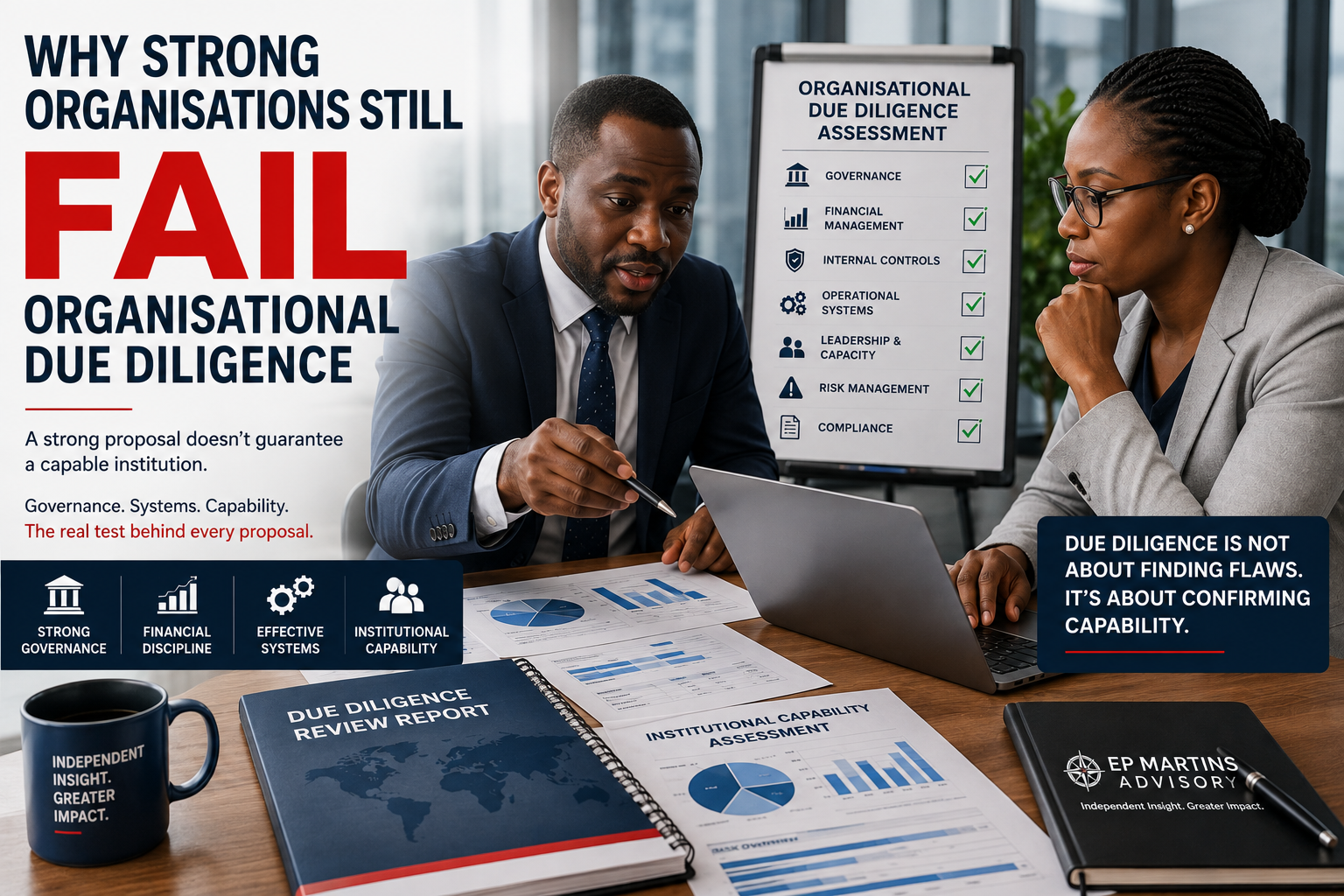
Why Strong Organisations Still Fail Organisational Due Diligence
Winning a grant, securing donor funding or being selected as an implementing partner rarely depends on the proposal alone. While technical expertise and a compelling implementation plan are essential, they represent only part of the equation. Organisational due diligence determines whether an organisation has the governance, leadership, financial management and operational capability to consistently deliver on what it has promised.
Many organisations assume that once a proposal is approved, the difficult part is over. In reality, experienced funders know that the proposal demonstrates intent, while organisational due diligence evaluates whether that intent can be translated into successful implementation.
It is often at this stage that otherwise impressive organisations unexpectedly fall short—not because they lack expertise, but because their institutional systems fail to inspire confidence.
When Due Diligence Changes the Conversation
A well-written proposal.
A capable technical team.
Strong references.
A compelling implementation approach.
The evaluation panel leaves convinced they have found the right organisation.
Then the due diligence begins.
The assessor requests the Board minutes.
They are available.
Every meeting concludes with the same statement:
“Approved as presented.”
There is no evidence of constructive debate.
No record of strategic oversight.
No discussion of emerging risks.
No indication that difficult decisions were challenged before being approved.
Technically, governance exists.
Practically, it is difficult to see how governance influences the organisation.
For experienced Grants Managers, Procurement Managers and Programme Directors, this is an immediately recognisable moment. The conversation quietly shifts.
The proposal is no longer the focus.
The organisation is.
A Proposal Wins Opportunities. An Institution Delivers Them.
Proposal evaluations answer one important question:
Can this organisation explain what it intends to do?
Organisational due diligence answers another:
Can this organisation consistently deliver what it has promised?
The distinction is subtle but significant.
A proposal demonstrates technical understanding.
Due diligence evaluates institutional capability.
Experienced funders understand that organisations are not truly tested when projects run smoothly.
They are tested when:
- Reporting deadlines overlap.
- Programme implementation becomes more complex than expected.
- Key personnel leave unexpectedly.
- Budgets require adjustment.
- Operational risks emerge.
- Difficult leadership decisions become unavoidable.
During these moments, governance, financial management and organisational systems stop being administrative functions.
They become the foundation of successful programme delivery.
What Organisational Due Diligence Really Assesses
Many organisations believe due diligence is simply a review of policies and compliance documents.
In reality, organisational due diligence is a comprehensive assessment of institutional capability. It seeks to answer one fundamental question:
Can this organisation responsibly manage resources and consistently deliver results?
Experienced assessors evaluate areas such as:
- Governance effectiveness
- Board oversight and accountability
- Financial management systems
- Internal controls
- Leadership capability
- Procurement processes
- Risk management
- Operational systems
- Compliance frameworks
- Organisational resilience
- Decision-making processes
- Programme management capacity
Collectively, these areas provide a much clearer picture of organisational maturity than documentation alone.
Due Diligence Doesn’t Create Problems
Many organisations approach due diligence as though it is an examination designed to uncover weaknesses.
Experienced executives see it differently.
Due diligence rarely creates problems.
It reveals problems that already existed.
If governance appears weak during an assessment, the review did not weaken governance.
If financial controls appear inconsistent, the assessment did not create inconsistency.
If accountability appears unclear, due diligence did not cause it.
The process simply makes existing organisational realities visible.
This explains why experienced assessors often identify concerns that surprise management.
Not because they discovered something new.
Because they observed what had always been there.
Documents Don’t Build Confidence
One of the most common mistakes organisations make is preparing for organisational due diligence by improving documentation alone.
Policies are updated.
Registers are completed.
Files become easier to navigate.
Documentation certainly matters.
However, documents describe intended practice.
They do not necessarily describe organisational reality.
The organisations that inspire the greatest confidence during due diligence are rarely those with the largest collection of policies.
They are the organisations whose answers remain consistent regardless of who is interviewed.
Whether speaking with the CEO, Finance Manager, Programme Director or Board Chair, the same governance structures, financial controls and operational processes are evident.
That consistency demonstrates something documentation cannot.
It demonstrates that the organisation functions through systems—not personalities.
Governance Is the Difference Between Compliance and Confidence
Strong governance is one of the clearest indicators of institutional maturity.
Effective boards do far more than approve reports.
They question assumptions.
They challenge management.
They evaluate strategic risks.
They oversee financial sustainability.
They strengthen accountability.
Organisations with active governance structures consistently perform better during due diligence because they demonstrate that oversight is embedded in everyday decision-making rather than existing only on paper.
Experienced funders recognise this immediately.
Strong Systems Outlast Strong Individuals
Many organisations owe their success to talented individuals.
The strongest organisations, however, are built on systems.
When leadership changes, operations continue.
When staff leave, knowledge remains.
When programmes expand, governance scales.
This institutional resilience is exactly what organisational due diligence seeks to verify.
Funders are investing in institutions—not individuals.
They need confidence that delivery will continue regardless of personnel changes.
Confidence Is Built Long Before Due Diligence Begins
Strong organisations rarely prepare for due diligence.
They prepare for delivery.
Weak organisations improve documentation before an assessment.
Strong organisations strengthen governance, clarify accountability, improve financial discipline and continuously improve operational systems.
By the time due diligence begins, there is very little left to prepare.
The assessment simply validates how the organisation already operates.
That is why the strongest institutions rarely experience due diligence as an obstacle.
They experience it as confirmation.
Why Organisational Due Diligence Matters for Development Partners
Every funding decision involves uncertainty.
Whether the funder is a donor agency, development finance institution, philanthropic foundation or financial institution, the objective is the same:
Reduce implementation risk while maximising development impact.
Independent organisational due diligence enables decision-makers to:
- Reduce financial and operational risk.
- Assess institutional capability objectively.
- Verify governance effectiveness.
- Evaluate financial management systems.
- Confirm operational readiness.
- Protect donor resources.
- Improve programme success rates.
- Strengthen accountability.
Ultimately, due diligence is not about eliminating every possible risk.
It is about determining whether confidence is justified.
How EP Martins Helps
At EP Martins Advisory, we support development partners, financial institutions, foundations and grant-making organisations through independent organisational due diligence and institutional capability assessments.
Our assessments go beyond document reviews to evaluate:
- Governance effectiveness
- Financial management
- Internal controls
- Leadership capability
- Operational systems
- Risk management
- Compliance
- Institutional resilience
By combining document reviews, stakeholder interviews and operational assessments, we provide evidence-based insights that help clients make informed funding and partnership decisions with confidence.
Whether selecting implementing partners, awarding grants or entering strategic collaborations, our due diligence services provide the assurance that organisations possess the institutional capability required to deliver sustainable results.
Final Insight
The organisations that consistently perform well during organisational due diligence are rarely those that prepared hardest for the assessment.
They are the organisations that invested in governance long before anyone requested the documents.
They strengthened financial discipline before budgets were scrutinised.
They built resilient operational systems before implementation challenges emerged.
And they embedded accountability into their culture before funders ever asked questions.
Ultimately, organisational due diligence is not evaluating the proposal.
It is evaluating the institution behind the proposal.
The strongest proposals may win opportunities.
Strong institutions deliver lasting impact.
Frequently Asked Questions
What is organisational due diligence?
Organisational due diligence is an independent assessment of an organisation’s governance, financial management, leadership, operational systems, internal controls and institutional capability. It helps funders determine whether an organisation can responsibly manage resources and consistently deliver programme outcomes.
Why is organisational due diligence important?
Organisational due diligence reduces funding risk by assessing whether an organisation has the governance structures, financial discipline and operational systems required to implement projects successfully. It provides confidence that resources will be managed effectively and objectives achieved.
What should funders verify before selecting an implementing partner?
Funders should assess governance effectiveness, board oversight, financial management systems, internal controls, procurement practices, leadership capability, operational processes, compliance and organisational resilience. Looking beyond documentation provides a more accurate picture of institutional capability.
What risks does organisational due diligence commonly uncover?
Due diligence often identifies governance weaknesses, inconsistent financial controls, founder dependence, inadequate internal controls, operational inefficiencies, poor documentation and capacity gaps that could affect programme delivery. These issues usually exist before the assessment but become visible through a structured review.
Can an organisation appear strong but still fail due diligence?
Yes. Organisations may submit excellent proposals, employ experienced technical teams and provide strong references while lacking the governance, financial management and operational capability necessary to manage significant funding responsibly. This is why organisational due diligence remains a critical part of grant-making and procurement.
Continue Reading
A strong proposal demonstrates technical expertise. It does not necessarily demonstrate institutional capability.
In our next article, “How to Assess the Capacity of Local Implementing Partners,” we explore the practical indicators experienced funders use to distinguish technically strong organisations from those with the governance, systems and institutional capability required to consistently deliver sustainable results.
