
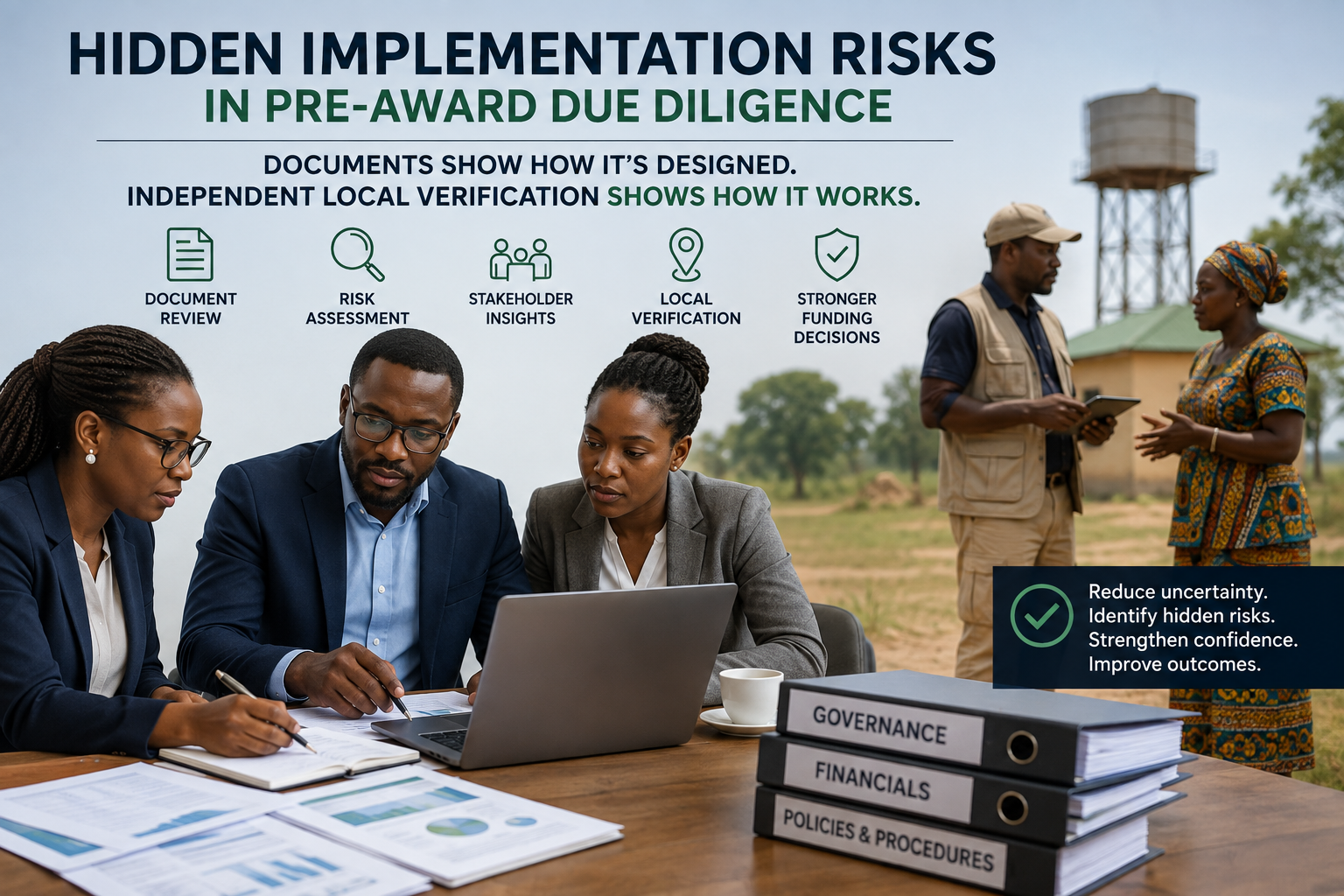
Hidden Implementation Risks in Pre-Award Due Diligence
Documents explain how a prospective implementing partner says it operates. Independent local verification helps explain how it actually operates. Yet, even after governance documents, financial statements and organisational policies have been reviewed, hidden implementation risks may remain undetected.
For many Grants Managers, Procurement Managers, development partners and DFI Investment Officers, this raises an important question: Do the documents fully reflect how an organisation will perform once implementation begins?
The documentation may be complete. The organisation may appear ready for award. But hidden implementation risks can emerge when documentary evidence is not tested against organisational behaviour, local operating realities and independent verification.
Hidden Implementation Risks Are Not Always Documentary
Strong pre-award due diligence establishes institutional capability through governance structures, financial management, internal controls, policies and documented procedures.
However, some of the most important implementation risks emerge outside the documents.
They become visible when documentary evidence is considered alongside organisational behaviour, leadership practices, stakeholder relationships, local operating realities and independent verification.
These risks do not necessarily prevent an organisation from receiving an award.
Instead, they may influence what happens after the award is made.
An organisation may have sound financial policies but struggle to apply them consistently. A management structure may appear robust, yet decision-making may depend heavily on one individual. A programme team may demonstrate technical competence but struggle to coordinate with government agencies, communities or other implementing partners.
These are hidden implementation risks because they may not be immediately apparent through conventional documentary review.
This is why effective pre-award due diligence should go beyond asking:
“Does the organisation have the required systems?”
It should also ask:
“Do those systems work effectively in practice?”
What Pre-Award Due Diligence Documents Don’t Show
Documents are essential.
They establish a foundation for assessing an organisation’s governance, financial position, compliance environment and institutional capacity.
But documents primarily explain how an organisation is designed to operate.
They do not always show how it behaves when implementation becomes difficult.
Consider two prospective implementing partners with similar governance structures, comparable financial statements and equally positive management interviews.
On paper, both may appear equally capable.
During implementation, however, their performance may be very different.
One organisation may escalate risks early, communicate challenges transparently and adapt quickly when circumstances change.
Another may delay difficult decisions, conceal emerging challenges or wait until programme milestones have already been affected before escalating an issue.
One organisation may coordinate effectively across programme teams and external stakeholders.
Another may become dependent on a single decision-maker, creating bottlenecks that affect implementation.
Neither situation necessarily contradicts the documentary evidence.
The difference becomes visible through behaviour and operational experience.
This is why strong pre-award due diligence should not only establish whether policies exist. It should consider whether the organisation has the behavioural, operational and leadership capacity to apply them effectively.
Why Hidden Implementation Risks Matter Across African Markets
Programme delivery across African markets can involve complex relationships between donors, development partners, governments, regulators, financial institutions, implementing partners, communities and other stakeholders.
These relationships can significantly influence implementation.
A prospective partner may have strong internal systems but operate within an environment where regulatory requirements, stakeholder expectations, market conditions or institutional relationships create additional operational considerations.
For cross-border programmes, the complexity can increase further.
Different countries may have different regulatory environments, institutional structures, stakeholder expectations and operating practices.
This makes independent local verification particularly valuable.
Independent verification can help funders understand whether the organisation’s documented capabilities are reflected in its actual operating environment.
It can provide additional insight into questions such as:
- How is the organisation perceived by relevant stakeholders?
- Does its reported operating presence reflect reality?
- How does leadership engage with external stakeholders?
- Does the organisation have credible implementation experience?
- Are stated systems consistently applied?
- Are there operational dependencies that could affect programme delivery?
- How effectively does the organisation respond when challenges arise?
The objective is not to replace documentary due diligence.
It is to test documentary evidence against operational reality.
What Experienced Funders Look For Beyond Documentation
Experienced funders understand that organisational capability is more than a collection of policies and procedures.
They look for evidence that capability is reflected in practice.
This can involve asking deeper questions about the organisation’s previous implementation experience and how it responded to real-world challenges.
How has the organisation responded when implementation became difficult?
Past behaviour can provide valuable insight into how an organisation may respond to future challenges.
Did leadership identify risks early?
Did it communicate problems transparently?
Did it adapt its approach when circumstances changed?
How are difficult decisions made?
Decision-making structures can significantly influence programme performance.
An organisation that has clear accountability and effective delegation may respond more quickly to implementation challenges than one where most decisions depend on a single individual.
How does leadership coordinate implementation?
Complex programmes often require coordination across departments, partners, government institutions and communities.
Understanding how leadership manages these relationships can reveal operational strengths and potential weaknesses.
How effectively does the organisation manage risk?
A policy stating that an organisation has a risk-management framework is useful.
Evidence of how that framework has been applied during previous challenges is even more informative.
Does the documented organisation match the operating organisation?
This is one of the most important questions.
The objective of independent verification is not simply to find negative information.
It is to establish whether the organisation represented in the documents is consistent with the organisation operating in the real world.
How Independent Local Verification Identifies Hidden Risks
Independent local verification adds another layer of confidence to the pre-award due diligence process.
Rather than relying exclusively on information supplied by the prospective implementing partner, funders can obtain independent perspectives on the organisation’s operating environment and capabilities.
Depending on the assignment, this may involve assessing:
- Organisational presence and operations
- Leadership and decision-making practices
- Stakeholder relationships
- Previous programme implementation experience
- Local reputation and credibility
- Operational capacity
- Regulatory and institutional relationships
- Programme delivery structures
- Potential dependency on key individuals
- Consistency between documented systems and operational practice
This approach helps identify areas that may warrant further examination before an award is finalised.
Importantly, independent local verification is not about assuming that an organisation is hiding something.
It is about recognising that no single source of information provides the complete picture.
Documents provide one perspective.
Management interviews provide another.
Independent local verification provides another.
When these perspectives are considered together, funders can make more informed decisions.
Strong Due Diligence Should Reduce Uncertainty Before Award
No due diligence process can eliminate every implementation risk.
However, the objective of pre-award due diligence is to reduce avoidable uncertainty before funding is committed.
This distinction is important.
The question is not whether a prospective implementing partner is completely risk-free.
Very few organisations are.
The more useful question is:
Are the material risks understood, assessed and manageable?
Where risks are identified before an award, funders may have more options.
They may strengthen contractual requirements, introduce additional reporting mechanisms, provide targeted capacity support, establish specific milestones or develop appropriate monitoring arrangements.
When risks remain hidden until implementation begins, the available options may become more limited—and the cost of addressing them may increase.
This is why identifying hidden implementation risks before an award can strengthen both funding decisions and programme delivery.
How EP Martins Helps
Independent Pre-Award Due Diligence Across African Markets
EP Martins supports development partners, foundations and DFIs through independent pre-award due diligence across African markets.
Our approach combines documentary review, local verification and operational assessment to help identify hidden implementation risks before funding decisions are made.
We assess more than whether documentation exists.
We help funders understand whether documented capabilities are supported by operational reality.
Our approach can help provide insight into:
- Governance and institutional capacity
- Financial and operational controls
- Organisational capability
- Leadership and decision-making
- Stakeholder relationships
- Local operating realities
- Implementation capacity
- Potential operational risks
- Areas requiring further assessment or mitigation
The objective is not simply to confirm compliance.
It is to strengthen confidence before grant and contract awards are made.
For organisations funding programmes across African markets, this additional perspective can help bridge the gap between what is documented and what is operationally real.
Final Reflection
Strong pre-award due diligence establishes institutional capability.
Exceptional pre-award due diligence goes further by identifying hidden implementation risks before funding decisions are made.
Because documents explain how a prospective implementing partner says it operates.
Independent local verification helps explain how it actually operates.
And for funders, development partners and DFIs making decisions in complex operating environments, that distinction can make the difference between simply approving an organisation and making a decision with greater confidence.
Frequently Asked Questions
What implementation risks can pre-award due diligence miss?
Pre-award due diligence can miss risks that documentary evidence alone cannot reveal, including organisational behaviour, decision-making practices, stakeholder coordination, implementation capability and local operating realities.
What should pre-award due diligence verify beyond documents?
Effective pre-award due diligence should reconcile documentary evidence with organisational behaviour, independent local verification and the realities of the operating environment to identify hidden implementation risks before funding decisions are made.
Why can organisations experience implementation challenges after passing due diligence?
Passing due diligence does not eliminate every implementation risk. Challenges can still emerge when operational, behavioural or local risks were not identified or sufficiently assessed before funding was approved.
How can funders identify hidden implementation risks?
Funders can combine documentary review with management interviews, independent local verification and operational assessment to determine whether an organisation’s documented capabilities reflect how it actually operates.
Why is independent local verification important across African markets?
Programme delivery across African markets often involves multiple stakeholders, institutions and operating environments. Independent local verification helps determine whether documented systems and capabilities are consistently reflected in practice.
Does independent verification replace traditional due diligence?
No. Independent verification complements traditional due diligence by providing additional evidence about an organisation’s operational reality, stakeholder relationships and implementation environment.
What is the purpose of pre-award due diligence?
The purpose of pre-award due diligence is to help funders assess the institutional, financial, operational and implementation capacity of a prospective partner and identify material risks before funding is committed.
Continue Reading
Understanding hidden implementation risks strengthens pre-award due diligence.
The next question is when independent verification becomes most valuable.
In the next article, “When Should International Organisations Use Independent Third-Party Due Diligence in Africa?”, we examine when independent due diligence can provide the greatest value before funding decisions are made.
Written by EP Martins Advisory
