
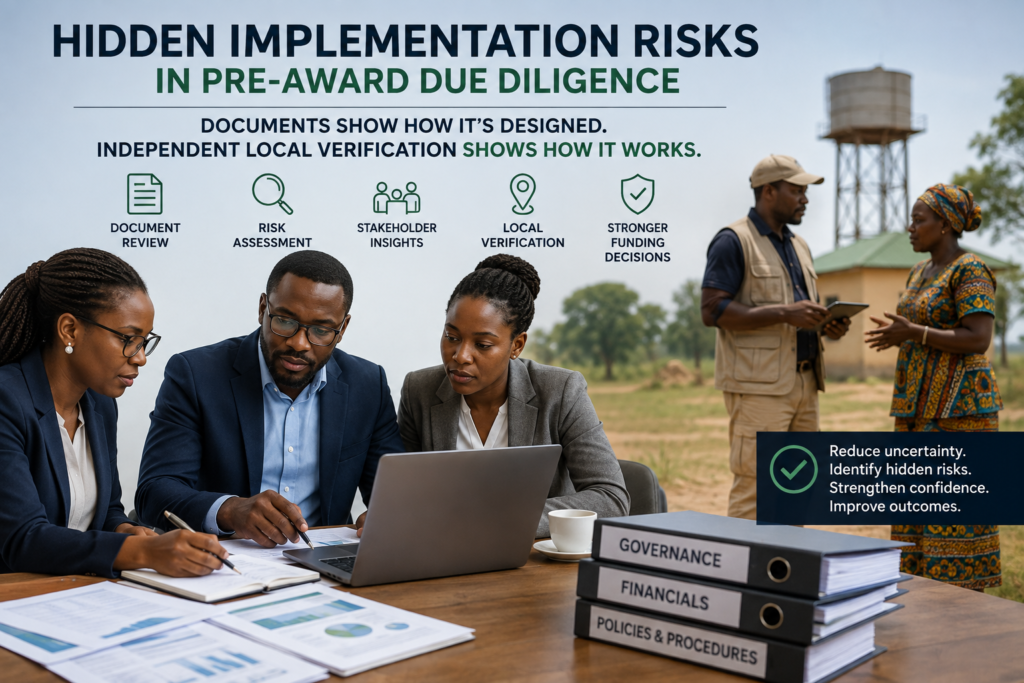
Implementation Risk Assessment: Hidden Risks Before Programme Mobilisation
An Implementation Risk Assessment helps identify the governance, staffing, operational and coordination risks that can affect programme delivery before mobilisation begins.
Programme mobilisation is only weeks away, and implementation planning appears complete. Yet familiar questions continue to surface. Who approves implementation decisions? Are key implementation positions filled? Have implementing partners aligned on their respective responsibilities? Are operational systems ready to support delivery?
This is where an Implementation Risk Assessment becomes critical. It helps identify governance, staffing, partner coordination and operational risks before they disrupt programme delivery.
The programme has not yet started.
Yet uncertainty is already growing.
Mobilisation Reveals What Planning Could Not
Implementation risk is often viewed as something that develops during programme delivery.
In practice, mobilisation is the first point at which programme planning is tested against operational reality.
Many implementation risks do not originate during mobilisation. They emerge much earlier — during programme planning, implementation design and operational preparation.
An Implementation Risk Assessment helps identify these risks before they become operational problems.
Mobilisation simply reveals whether governance arrangements are operational, implementation partners are aligned and delivery systems are genuinely ready to support implementation.
Unclear governance delays decisions.
Weak coordination disrupts implementation.
Immature operational systems slow delivery.
Mobilisation does not create these challenges. It exposes them.
Why an Implementation Risk Assessment Matters Across African Markets
Across African markets, programmes often span multiple countries, implementing partners and institutional environments.
Government processes, institutional capacity and delivery ecosystems differ between locations. This means implementation arrangements cannot simply be assumed from programme design.
These realities become visible as organisations prepare to mobilise.
An Implementation Risk Assessment provides a structured way to examine whether the programme’s governance, operational systems, staffing, partnerships and delivery arrangements are ready for the environments in which implementation will actually take place.
This is particularly important for programmes operating across multiple countries, where a weakness in one part of the implementation structure can affect delivery across the wider programme.
That is why experienced development partners assess implementation arrangements as carefully as implementation plans.
What Should an Implementation Risk Assessment Examine?
Before mobilisation, experienced development partners confirm that:
- programme governance is operational;
- leadership responsibilities and decision-making authority are clear;
- operational and financial management systems are ready;
- key implementation positions have been filled;
- implementing partners have a shared understanding of delivery responsibilities; and
- country-level implementation arrangements reflect local operating realities.
These areas provide an important foundation for an effective Implementation Risk Assessment.
The most common implementation risks relate to governance, staffing, partner coordination, operational systems and country-level implementation arrangements.
If a programme is approaching mobilisation, these questions are significantly easier to answer before implementation begins than after delivery is already underway.
The objective is not to eliminate every implementation risk.
It is to reduce avoidable uncertainty before delivery begins.
Why Implementation Risk Assessment Should Happen Before Mobilisation
Once implementation begins, even relatively straightforward issues can become more disruptive and costly to resolve.
Governance gaps delay decisions.
Weak operational systems interrupt delivery.
Unclear responsibilities create duplication and coordination challenges.
Staffing gaps place pressure on existing teams.
Misaligned implementing partners can slow programme execution.
Addressing these issues before mobilisation is usually simpler, faster and less disruptive than resolving them during implementation.
This is why an Implementation Risk Assessment should form part of programme preparation rather than being treated as a response to problems after implementation has started.
The earlier risks are identified, the more opportunity there is to address them before they affect programme performance.
The Questions Experienced Development Partners Ask
Before programme mobilisation, experienced development partners ask practical questions:
Is the governance structure ready to make decisions?
Are the right people in place to lead implementation?
Do implementing partners understand their responsibilities?
Are financial and operational systems capable of supporting delivery?
Are country-level arrangements realistic for the environments in which the programme will operate?
Have the most significant implementation risks been identified and assigned appropriate mitigation actions?
These questions move implementation planning beyond documentation.
They test whether the programme is genuinely prepared to operate.
That distinction matters.
A programme can have a comprehensive implementation plan and still have significant implementation risks.
An Implementation Risk Assessment helps bridge the gap between what has been planned and what is actually ready for delivery.
The Real Value of an Implementation Risk Assessment
The purpose of an Implementation Risk Assessment is not simply to produce another risk register.
Its real value is in providing decision-makers with evidence about whether critical implementation arrangements are sufficiently prepared before mobilisation begins.
It can help organisations identify:
- governance weaknesses;
- unclear decision-making authority;
- staffing and capacity gaps;
- operational and financial system weaknesses;
- partner coordination risks;
- country-level implementation challenges; and
- areas requiring action before programme launch.
This allows programme leaders and development partners to address material weaknesses while there is still time to do so.
Readiness is not about assuming that everything will go according to plan. It is about understanding what could prevent effective implementation — and addressing those risks early.
Frequently Asked Questions
What is an Implementation Risk Assessment?
An Implementation Risk Assessment is a structured review of the governance, people, systems, partnerships and operational arrangements that could affect successful programme implementation. It helps identify significant risks before mobilisation and delivery begin.
What implementation risks should be assessed before mobilisation?
Development partners should assess governance, leadership, operational systems, staffing, financial management, partner coordination and country-level implementation arrangements before mobilisation begins.
How do development partners reduce implementation risk?
They undertake an Implementation Risk Assessment to identify governance, operational, organisational and coordination risks and determine which issues should be addressed before programme delivery begins.
What should be verified before programme start-up?
Governance arrangements, operational systems, staffing, financial management, decision-making authority and delivery responsibilities should be sufficiently established before programme mobilisation.
Why do implementation challenges emerge immediately after programme launch?
Programme launch rarely creates new implementation risks. Instead, it often exposes governance, operational and coordination issues that were not fully resolved during programme planning and preparation.
What implementation risks should be addressed before programme mobilisation?
Priority risks include governance gaps, unclear decision-making authority, operational system weaknesses, staffing shortages, partner coordination challenges and implementation arrangements that do not reflect local operating realities.
Understanding implementation risks is only part of the solution.
The next step is determining whether an organisation is genuinely prepared to begin delivery.
In the next article, “What Is an Implementation Readiness Assessment? The Critical Stage Between Award Decision and Programme Mobilisation,” we examine how implementation readiness assessments provide structured evidence that governance, systems, resources and delivery arrangements are ready before programme mobilisation begins.
Because the strongest programmes do not wait for implementation to reveal what preparation should have identified.
Written by EP Martins Advisory