
Third-party due diligence in Africa provides international organisations with an independent way to verify implementing partners, assess potential risks and strengthen funding decisions before an award is made.
The preferred implementing partner has been identified. The technical evaluation is complete. The proposal is strong, the budget has been agreed and the award recommendation is ready.
But one important question remains:
Do we have sufficient confidence to commit the funding?
For international organisations operating across African markets, answering that question may require more than reviewing documents submitted by a prospective partner.
This is where third-party due diligence in Africa can provide an additional layer of independent assurance before funding is committed.
What Is Third-Party Due Diligence in Africa?
Third-party due diligence in Africa is an independent assessment of a prospective implementing partner, supplier, organisation or other third party before a significant decision is made.
Unlike an internal review conducted by the funding organisation, independent due diligence introduces an external perspective.
The assessment may combine:
- Documentary and corporate record review
- Verification of organisational information
- Regulatory and legal checks
- Local market verification
- Reference checks
- Physical or operational verification where appropriate
- Assessment of governance and organisational capacity
- Identification of potential integrity, operational or reputational risks
- Independent professional judgement
The objective is not necessarily to determine whether an organisation should receive funding.
Instead, it is to help the funder understand who they are dealing with, what risks may exist and what safeguards may be appropriate before the award is made.
Why Third-Party Due Diligence in Africa Matters
African markets are diverse. Regulatory environments, business practices, institutional capacity and access to reliable information can vary considerably between countries and sectors.
For international organisations, this can make relying solely on information provided during a procurement, grant or partner selection process insufficient in some circumstances.
Third-party due diligence in Africa can help bridge that information gap by independently testing important information before a funding decision is finalised.
This can provide greater visibility into areas such as:
- Ownership and control
- Registration and legal status
- Governance structures
- Financial and operational capacity
- Physical presence
- Reputation and market standing
- Relationships with relevant stakeholders
- Ability to deliver the proposed programme
- Potential compliance or integrity concerns
The value lies in converting information into greater decision confidence.
When Does Independent Due Diligence Create the Greatest Value?
Not every award requires the same level of independent scrutiny.
The need for third-party due diligence in Africa generally becomes more relevant when the consequences of getting the decision wrong are significant.
For example, additional assurance may be valuable when:
The Partner Is New to the Organisation
A new implementing partner may have limited history with the international organisation.
Even where the proposal and technical evaluation are strong, independent verification can provide additional confidence before the relationship begins.
The Programme Is Multi-Country
A partner operating across several African markets may face different regulatory, operational and governance environments.
A multi-country programme can therefore introduce additional complexity that may justify independent local verification.
The Funder Has Limited Local Presence
An international organisation may have strong technical expertise but limited personnel on the ground in a particular country.
Independent local verification can help bridge that geographical gap.
The Funding Carries Significant Risk
Where funding is substantial, programmes are politically or operationally sensitive, or implementation risks are elevated, additional independent assurance can support the funding decision.
Governance Requires Independent Assurance
Some organisations have governance, compliance, donor or internal control requirements that call for independent verification before an award is approved.
In these circumstances, third-party due diligence in Africa becomes part of a broader assurance framework rather than simply another administrative exercise.
Why Documentary Review Alone May Not Be Enough
Documents are an important starting point for due diligence.
However, documents can only tell part of the story.
A registration certificate may confirm that an organisation exists. A financial statement may provide information about its financial position. A proposal may demonstrate technical understanding of a programme.
But these documents may not answer every practical question.
For example:
- Does the organisation maintain an operational presence at the stated location?
- Are key personnel actually associated with the organisation?
- Does the organisation have a credible reputation among relevant stakeholders?
- Does its stated operational capacity correspond with what can be independently verified?
- Are there inconsistencies between submitted information and information available locally?
This is why third-party due diligence in Africa can go beyond documentary assessment to include local verification.
The Importance of Local Verification
Local verification is particularly valuable in markets where information may be fragmented across different institutions, databases and networks.
Depending on the assignment, verification may involve speaking with relevant stakeholders, confirming physical locations, reviewing publicly available records or validating information through appropriate local channels.
The purpose is not to conduct intrusive investigations.
It is to test material information and establish whether the picture presented on paper aligns with what can be independently verified.
For international organisations, this distinction can be important.
A partner may appear suitable based on documentation while additional verification reveals areas requiring clarification, mitigation or monitoring.
Equally, independent verification may confirm that the partner is credible and that identified concerns are manageable.
That is why third-party due diligence in Africa should not be viewed solely as a mechanism for finding problems.
It is a mechanism for increasing confidence in the decision.
When Should an International Organisation Consider Third-Party Due Diligence in Africa?
There is no single threshold that applies to every organisation or every award.
The decision should reflect the organisation’s risk appetite, governance requirements, programme context and the nature of the proposed relationship.
However, third-party due diligence in Africa may be particularly relevant when several of the following factors are present:
- The implementing partner is new or relatively unknown.
- The organisation has limited experience in the relevant country.
- The programme will operate across multiple jurisdictions.
- The funding amount is material.
- The programme is operationally complex.
- The organisation has limited local presence.
- There are gaps or inconsistencies in available information.
- The programme carries heightened reputational or compliance considerations.
- Internal governance requires independent assurance.
- The consequences of implementation failure could be significant.
The more uncertainty exists around the partner, programme or operating environment, the greater the potential value of independent verification.
Third-Party Due Diligence in Africa Is About Confidence, Not Suspicion
It is important to distinguish due diligence from an investigation driven by an assumption that something is wrong.
Third-party due diligence in Africa is fundamentally an assurance exercise.
An assessment may identify risks that require further action. But it may also provide evidence that supports proceeding with the proposed relationship.
In some cases, the outcome may be:
- Proceed with the award.
- Proceed subject to specific safeguards.
- Strengthen monitoring requirements.
- Request additional documentation or clarification.
- Introduce capacity-building measures.
- Reconsider elements of the proposed implementation arrangement.
The purpose is therefore not simply to say “yes” or “no.”
It is to give decision-makers better information on which to base their decision.
How Independent Third-Party Due Diligence Supports Better Funding Decisions
A funding decision involves more than determining whether a proposal is technically sound.
Decision-makers also need confidence that the organisation responsible for implementation has the appropriate structures, capacity and operating environment to deliver.
Independent third-party due diligence in Africa can contribute by providing an additional perspective on the partner before funding is committed.
It can help answer questions such as:
Who is the organisation?
Independent verification can establish important information about identity, ownership, registration and organisational structure.
Can the organisation operate as proposed?
Local and documentary checks can provide insight into physical presence, personnel, systems and operational capacity.
Are there material risks that should be considered?
The assessment can highlight information requiring clarification, mitigation or further monitoring.
What safeguards may be appropriate?
Rather than simply identifying risks, due diligence can help inform proportionate controls and conditions.
This creates a more informed basis for funding decisions.
Pre-Award Due Diligence and Technical Evaluation Are Not the Same
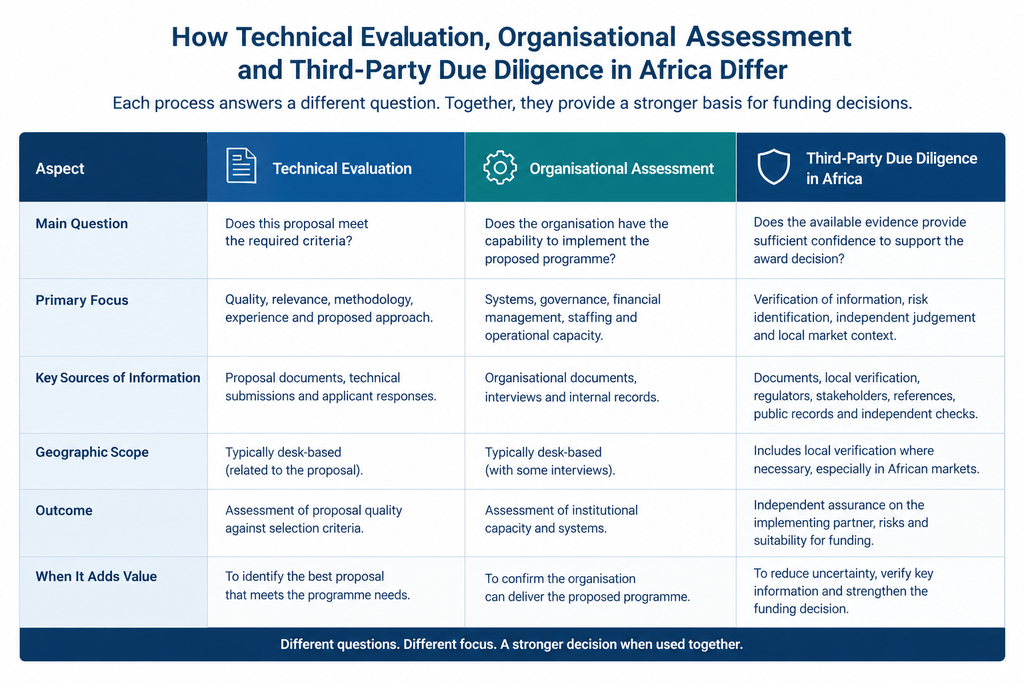
Technical evaluation and third-party due diligence in Africa answer different questions.
Technical Evaluation
Technical evaluation typically considers whether a proposal meets the programme’s requirements.
It may assess:
- Technical approach
- Programme design
- Methodology
- Experience
- Team composition
- Value for money
- Proposed results
The central question is:
Can this proposal meet the programme objectives?
Organisational Assessment
An organisational assessment may examine the prospective partner’s internal systems, governance, financial management and operational capacity.
The question becomes:
Does the organisation have the capacity and systems to deliver?
Third-Party Due Diligence
Independent third-party due diligence in Africa adds another layer by independently verifying material information and identifying issues that may not be apparent from the submitted documentation alone.
The question becomes:
What can we independently verify about this organisation and the risks associated with proceeding?
These processes can therefore complement one another rather than compete with each other.
Can Third-Party Due Diligence in Africa Be Conducted Remotely?
Yes, depending on the assignment.
Digital tools, public records, document reviews, interviews and remote verification can support many aspects of third-party due diligence in Africa.
However, remote assessment has limitations.
Some questions are better answered through local verification.
For example, where the existence of an operational facility, local reputation, physical presence or other market-specific information is material to the funding decision, an on-the-ground assessment may provide stronger assurance.
The appropriate methodology should therefore reflect the risk, geography, available information and objectives of the assignment.
The question is not whether due diligence must always be conducted physically.
It is:
What level of independent verification is appropriate for the decision being made?
How EP Martins Helps
EP Martins Advisory supports international organisations and development-focused institutions with independent assurance across complex operating environments.
Our approach to third-party due diligence in Africa combines three core elements:
1. Documentary Review
We assess available corporate, legal, organisational and other relevant documentation to establish the initial picture.
2. Local Verification
Where required, we independently verify material information through appropriate local channels and market-level checks.
3. Independent Judgement
We bring together the available evidence to identify relevant considerations and provide an independent perspective for decision-makers.
This approach is designed to provide clarity without unnecessarily slowing down the funding process.
Independent Third-Party Due Diligence Across African Markets
For international organisations operating across Africa, consistency matters.
A partner assessment conducted in one country may involve different information sources and verification considerations from an assessment conducted in another.
An effective third-party due diligence in Africa approach therefore needs to be locally informed while maintaining a consistent professional methodology.
The objective is to provide decision-makers with information that is clear, relevant and proportionate to the funding decision.
This is particularly important for organisations managing programmes across multiple African markets.
The Cost of Uncertainty
The cost of due diligence is often easier to see than the cost of not conducting it.
However, uncertainty can become significantly more expensive after an award has been made.
Potential consequences may include:
- Implementation delays
- Weak programme delivery
- Additional monitoring requirements
- Reputational exposure
- Financial losses
- Contractual disputes
- Remediation costs
- Disruption to beneficiaries
- Management time spent resolving avoidable issues
Third-party due diligence in Africa does not eliminate these risks.
What it can do is provide decision-makers with more information before they commit resources and enter into a relationship.
That timing matters.
Once funding has been disbursed and implementation has begun, addressing certain risks can become considerably more difficult.
Third-Party Due Diligence in Africa: A Decision Before the Decision
The most important value of independent due diligence may be that it happens before the final decision.
By independently verifying relevant information, international organisations can move from:
“The documentation appears satisfactory.”
to:
“We have independently tested the information that matters to our decision.”
That distinction can be particularly valuable when funding decisions involve new partners, complex programmes, significant resources or unfamiliar operating environments.
FAQs About Third-Party Due Diligence in Africa
What is third-party due diligence in Africa?
Third-party due diligence in Africa is an independent assessment used to verify information about prospective partners, organisations or other third parties before an important decision, such as a funding award, is made.
Why do international organisations use third-party due diligence?
International organisations may use independent due diligence to verify material information, identify potential risks and strengthen confidence in funding or partnership decisions.
Is third-party due diligence only necessary for high-value awards?
Not necessarily. The appropriate level of due diligence depends on factors such as risk, organisational requirements, programme complexity, partner familiarity and the operating environment.
What does pre-award third-party due diligence examine?
Depending on the assignment, it can examine organisational identity, registration, ownership, governance, operational presence, reputation, capacity and other relevant areas.
Can due diligence be conducted remotely?
Some assessments can be conducted remotely. However, local verification may be appropriate where physical presence, local reputation or other market-specific information is material to the decision.
Is third-party due diligence the same as a technical evaluation?
No. A technical evaluation primarily assesses the quality and suitability of a proposal. Independent due diligence focuses on verifying relevant information and understanding risks associated with the prospective partner or third party.
Does due diligence mean the partner will be rejected?
No. Due diligence can support several outcomes, including proceeding with the award, introducing safeguards, requesting clarification, strengthening monitoring or identifying areas for capacity building.
Conclusion
For international organisations operating across African markets, a strong proposal is only one part of a sound funding decision.
The question is also whether the organisation behind the proposal can be independently verified and whether the available information provides sufficient confidence to proceed.
Third-party due diligence in Africa provides an additional layer of independent assurance by combining documentary review, local verification and professional judgement.
Used proportionately, it can help international organisations make better-informed funding decisions, strengthen governance and reduce avoidable uncertainty before resources are committed.
The objective is not to create unnecessary barriers.
It is to make important decisions with greater confidence.
EP Martins Advisory supports organisations seeking independent assurance across African markets. To discuss your due diligence, programme assurance or implementation requirements, contact our team.