How an Effective Operating Model Drives Consistent Strategy Execution
As organizations grow, an effective operating model becomes the foundation for faster decision-making, stronger governance, and consistent execution.
Growth is often seen as a measure of organizational success.
New markets are entered. Programmes expand. Regional offices are established. Partnerships increase. Leadership teams grow.
Yet with every stage of growth comes a less visible challenge.
Execution becomes harder to sustain.
Approvals take longer.
Teams wait for decisions.
Regional offices become increasingly involved in operational issues.
Leadership spends more time coordinating work than enabling it.
The strategy remains the same, but execution begins to look different across countries and teams.
At EP Martins Advisory, we have observed that this rarely happens because people become less capable.
Instead, it happens because organizations quietly outgrow their operating model.
What Is an Operating Model?
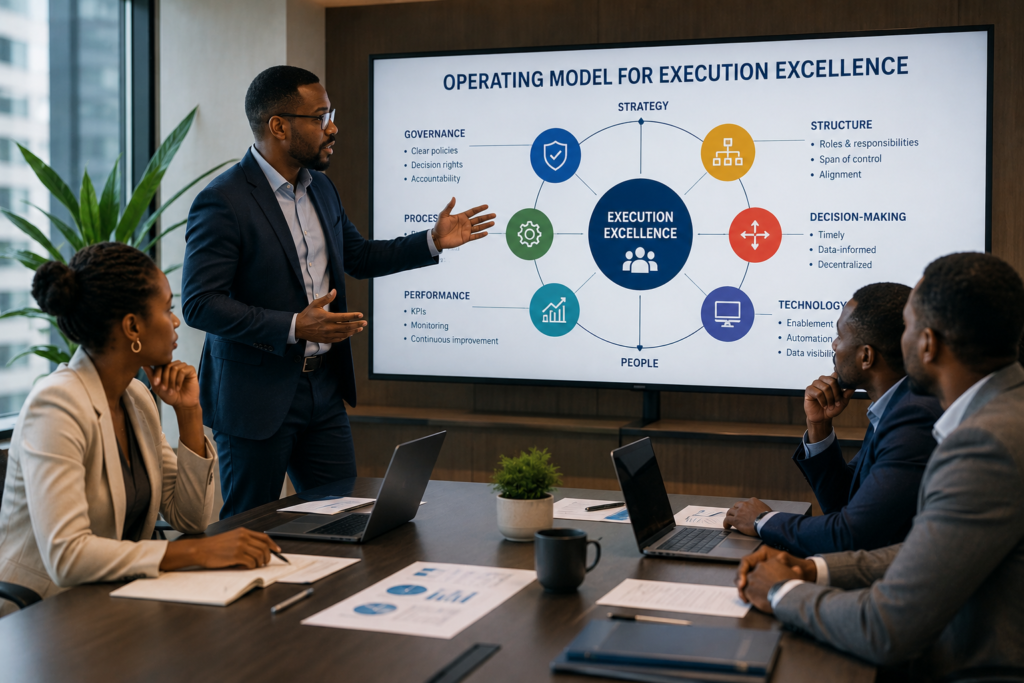
An operating model defines how an organization turns strategy into day-to-day execution. It provides the structure for how decisions are made, responsibilities are assigned, information flows, and accountability is maintained across the organization.
While an organizational chart shows who reports to whom, an operating model explains how work gets done.
A strong operating model ensures that strategy is translated into consistent action, regardless of where teams are located or how complex the organization becomes.
Without it, even the most capable teams can struggle to deliver consistent results.
Growth Tests Every Operating Model
Growth changes organizations in subtle ways.
One country team waits for approval before engaging a key stakeholder.
Another team moves ahead because programme timelines cannot wait.
A regional steering committee spends valuable time discussing issues that field teams resolved weeks earlier.
Everyone is acting responsibly.
Everyone is committed to achieving the organization’s objectives.
Yet execution becomes less consistent.
This is one of the clearest signs that an organization’s operating model is no longer keeping pace with its growth.
As organizations expand, complexity increases naturally.
There are more programmes to manage.
More countries to coordinate.
More stakeholders to engage.
More decisions to make.
The challenge is not growth itself.
The challenge is ensuring the operating model evolves alongside that growth.
Why Organizations Outgrow Their Operating Model
Many organizations respond to growth by introducing additional controls.
More approvals.
More meetings.
More reporting requirements.
More escalation points.
These changes often create the impression of stronger governance.
In reality, they frequently create slower decision-making.
Questions that were once resolved through a single conversation now pass through several people before anyone feels confident making a decision.
Country teams wait.
Regional leaders become overloaded.
Operational issues remain unresolved for longer.
The issue is rarely a lack of commitment.
Instead, the organization continues relying on an operating model that was designed for a smaller, less complex environment.
Yesterday’s way of working is trying to support tomorrow’s organization.
An Operating Model Shapes Decision-Making
The strongest organizations understand that execution depends on more than having talented people.
It depends on creating an operating model where everyone understands how decisions move through the organization.
Country teams know which decisions they own.
Regional leaders understand which issues require escalation.
Headquarters focuses on strategic direction rather than operational bottlenecks.
Information reaches decision-makers while it is still useful.
Leadership spends less time approving work and more time removing barriers that prevent execution.
In these organizations, control does not become weaker.
It becomes clearer.
When Decision-Making Slows, Execution Begins to Drift
Across different organizations, one pattern appears consistently.
When important decisions take longer, teams naturally begin adapting.
Local managers solve immediate problems.
Regional teams develop alternative processes.
Programme teams introduce new ways of working.
These decisions are rarely wrong.
Most are made with the best intentions.
However, over time they gradually produce different versions of the same operating approach.
What begins as local flexibility eventually becomes organizational inconsistency.
This is what we describe as Operational Drift.
Long before leadership notices inconsistent performance, the organization has often been experiencing increasing delays in decision-making.
The strongest organizations recognize these signals early and strengthen their operating model before inconsistency becomes embedded in everyday operations.
Building an Operating Model That Supports Growth
Organizations that continue executing effectively as they grow rarely succeed by adding more layers of management.
Instead, they deliberately design how work moves across the organization.
An effective operating model typically includes:
- Clearly defined decision ownership
- Governance that supports timely decisions
- Simple and transparent approval pathways
- Strong coordination between headquarters, regional offices, and country teams
- Reliable operational visibility
- Accountability at every level of the organization
- Decision-making that happens as close as possible to where the work is taking place
These capabilities allow organizations to grow without sacrificing consistency, responsiveness, or accountability.
Execution Architecture: The Missing Link
Over time, we have come to think about this capability as Execution Architecture.
Execution Architecture is not an organizational chart.
Nor is it simply a governance framework.
It is the organizational system that enables good decisions to happen quickly, consistently, and close to where work is taking place.
It combines:
- Decision-making
- Governance
- Communication
- Accountability
- Coordination
- Operational visibility
Together, these elements create an environment where strategy continues to translate into consistent execution—even as organizational complexity increases.
A Different Question for Leaders
As organizations grow, leaders often ask:
“Do we need another layer of management?”
A more valuable question may be:
“Does our operating model enable good decisions to happen where the work actually happens?”
Growth does not simply require organizations to make more decisions.
It requires them to make better decisions without everything depending on the same people.
That capability ultimately determines whether strategy continues to become consistent execution.
How EP Martins Advisory Helps Organizations Strengthen Their Operating Model
At EP Martins Advisory, we help organizations design operating models that improve execution, strengthen governance, and support sustainable growth across Africa.
Our advisory services include:
- Operating model design and transformation
- Organizational design
- Governance and accountability frameworks
- Decision-making frameworks
- Strategy execution
- Regional operating models
- Organizational effectiveness
- Leadership advisory
Our approach helps organizations reduce unnecessary complexity while improving coordination, accountability, and execution.
The result is an organization that can grow confidently without losing operational control.
Frequently Asked Questions
What is an operating model?
An operating model is the framework that defines how an organization delivers its strategy through people, governance, processes, decision-making, and accountability.
Why is an operating model important?
A strong operating model enables organizations to execute strategy consistently, improve decision-making, strengthen governance, and maintain alignment as they grow.
How do you know when your operating model needs to change?
Organizations should review their operating model whenever growth significantly increases the number of countries, programmes, teams, stakeholders, or implementation partners involved in delivery.
How does an operating model improve strategy execution?
An effective operating model ensures decisions are made at the appropriate organizational level, information flows efficiently, and governance supports execution rather than delaying it.
What is the difference between an organizational structure and an operating model?
An organizational structure defines reporting relationships. An operating model defines how decisions are made, work is coordinated, accountability is maintained, and strategy is translated into execution.
How can organizations build a better operating model?
Organizations improve their operating model by clarifying decision ownership, simplifying governance, strengthening communication, improving operational visibility, and ensuring accountability supports rather than slows execution.
Final Reflection
As organizations grow, success becomes less dependent on strategic planning alone and more dependent on the operating model that supports everyday execution.
The organizations that consistently deliver results are rarely those with the most detailed strategic plans.
They are the ones that deliberately design systems where good decisions happen quickly, accountability remains clear, and execution stays aligned across every team, region, and programme.
A well-designed operating model is not simply an operational framework, it is the engine that transforms strategy into measurable, sustainable results.
WRITTEN BY EP MARTINS