
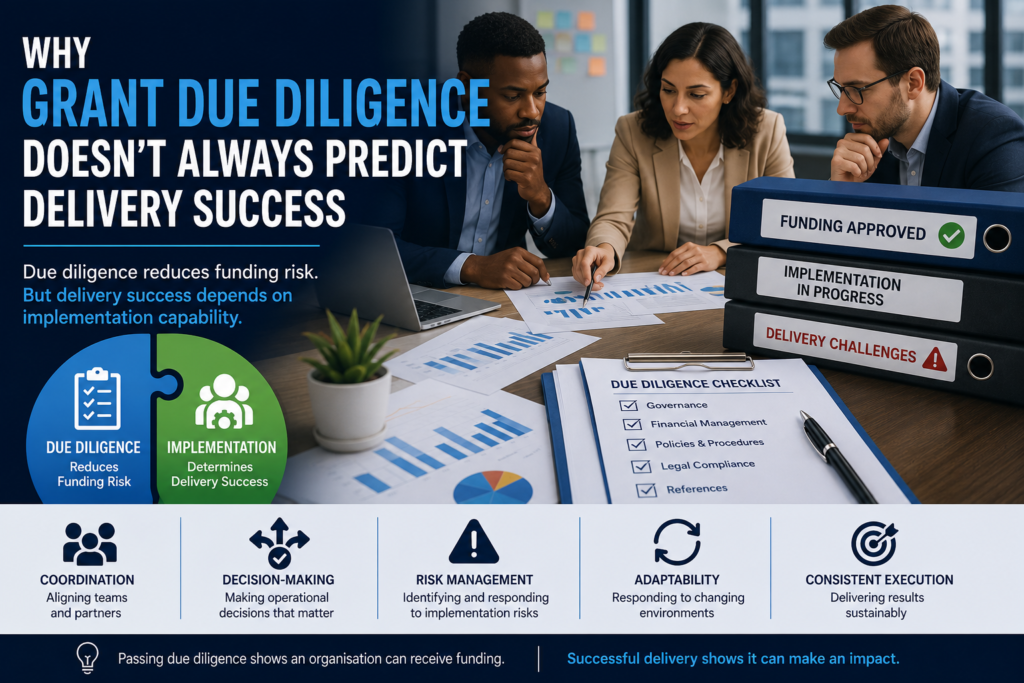
Why Grant Due Diligence Doesn’t Always Predict Programme Delivery Success
Grant due diligence is one of the most important processes in responsible funding. It gives funders confidence that an organisation has the governance, financial systems and compliance structures needed to responsibly receive and manage grant funding. Yet, despite passing grant due diligence, some organisations still struggle to deliver successful programmes once implementation begins.
The funding committee had confidence in its decision.
The organisation had successfully completed grant due diligence.
Its financial statements had been reviewed.
Governance structures were in place.
Policies had been assessed.
References had been verified.
There was no obvious reason to question the funding award.
Months later, implementation began falling behind.
Country teams were no longer aligned.
Stakeholder coordination became increasingly difficult.
Delivery milestones started slipping.
Months earlier, nothing in the grant due diligence process had suggested this outcome.
So how did an organisation that satisfied every pre-award requirement struggle to deliver?
The answer is rarely that the grant due diligence was inadequate.
Rather, it is that grant due diligence was answering a different question.
Grant Due Diligence Reduces Funding Risk
At its core, grant due diligence helps funders determine whether an organisation can responsibly receive and manage funding.
This requires assessing governance structures, financial management systems, legal compliance, internal controls, organisational policies and institutional credibility.
These are essential assessments.
They reduce funding risk.
However, they do not necessarily reduce delivery risk.
Receiving funding responsibly and executing a programme consistently are related—but fundamentally different—capabilities.
An organisation may demonstrate strong governance, sound financial controls and full compliance while still struggling to coordinate implementation, manage operational complexity or sustain delivery across multiple stakeholders.
This distinction is important.
Grant due diligence reduces funding risk. It does not eliminate delivery risk.
Programme Delivery Tests Something Different
Once implementation begins, organisations face realities that documents alone cannot fully demonstrate.
Teams interpret guidance differently.
Implementing partners coordinate activities across changing environments.
Managers respond to operational challenges.
Issues are escalated—or they are not.
Resources shift.
Priorities evolve.
Hundreds of operational decisions are made throughout programme implementation.
Collectively, these decisions determine whether delivery remains consistent, responsive and aligned with programme objectives.
These capabilities cannot be fully evaluated through policies, financial reports or governance documents alone.
That is why grant due diligence cannot always predict programme delivery success.
The Hidden Assumption Behind Grant Due Diligence
One assumption often goes unnoticed.
When an organisation successfully passes grant due diligence, it is easy to assume it is equally prepared to deliver.
These are two separate judgements.
Grant due diligence provides confidence that an organisation can responsibly receive funding.
Successful implementation requires confidence that the organisation can consistently execute what has been approved.
The difference may appear subtle during the funding decision.
In practice, it often determines whether programmes achieve their intended outcomes.
Recognising this distinction changes how funders think about implementation risk long before programme delivery begins.
Why Compliance Does Not Guarantee Programme Success
Compliance demonstrates that an organisation meets defined governance, financial and legal standards.
Those standards are essential for accountability.
But programme success depends on something different.
It depends on how effectively those structures translate into coordinated execution under real operating conditions.
An organisation may have excellent policies and governance while lacking consistent mechanisms for operational decision-making, cross-functional coordination, implementation oversight or adaptive management.
These are the capabilities that often determine whether implementation succeeds after funding has been approved.
What Funders Should Look Beyond During Grant Due Diligence
While grant due diligence remains an essential component of responsible funding decisions, it should not be the only source of confidence.
To better predict delivery success, funders should also seek evidence of an organisation’s implementation capability.
This includes understanding how the organisation:
- Coordinates programme implementation across teams and partners.
- Makes operational decisions during delivery.
- Identifies and manages implementation risks.
- Responds to changing operating environments.
- Maintains consistency across multiple locations and stakeholders.
- Translates approved funding into measurable programme outcomes.
This evidence provides greater confidence that an organisation is prepared not only to receive funding, but also to execute effectively once implementation begins.
Frequently Asked Questions
Why can an organisation pass grant due diligence and still struggle during implementation?
Because grant due diligence and programme delivery assess different capabilities. An organisation may satisfy governance, financial and compliance requirements while still facing challenges with operational coordination, decision-making and consistent execution.
Can grant due diligence predict whether an organisation will successfully deliver a programme?
Not on its own. Grant due diligence provides confidence that an organisation can responsibly manage funding, but it does not always demonstrate how effectively the organisation will execute once implementation begins.
What delivery risks remain after grant due diligence?
Grant due diligence does not always assess how an organisation will make operational decisions, coordinate implementation, respond to delivery challenges or maintain consistent execution across teams, partners and operating environments.
How can funders reduce delivery risk before awarding funding?
Funders can strengthen their decision-making by combining grant due diligence with evidence of implementation capability, operational coordination, delivery governance, decision-making processes and execution readiness.
Why doesn’t organisational compliance guarantee programme success?
Compliance demonstrates that an organisation meets governance, financial and legal requirements. Programme success depends on how effectively those systems translate into coordinated execution during implementation.
What evidence should funders seek beyond grant due diligence?
Beyond compliance, funders should seek evidence that an organisation can translate approved funding into coordinated implementation under real operating conditions. That evidence provides stronger confidence that the organisation is prepared to execute—not simply prepared to receive funding.
Conclusion
Grant due diligence remains one of the most important safeguards in responsible funding.
It helps funders understand whether an organisation is suitable to receive and manage grant funding.
What it does not necessarily reveal is whether that organisation is prepared to execute consistently once implementation begins.
The next question is therefore not whether grant due diligence is important.
It is what additional evidence best predicts successful implementation after funding has been approved.
That distinction is increasingly important for funders seeking not only accountable grant management, but reliable programme delivery and sustainable impact.
In the next article, What Grant Partner Assessments Often Miss, we explore why organisational capability and implementation capability are not always the same—and why that difference often becomes visible only after programmes begin.
Written by EP MARTINS ADVISORY